

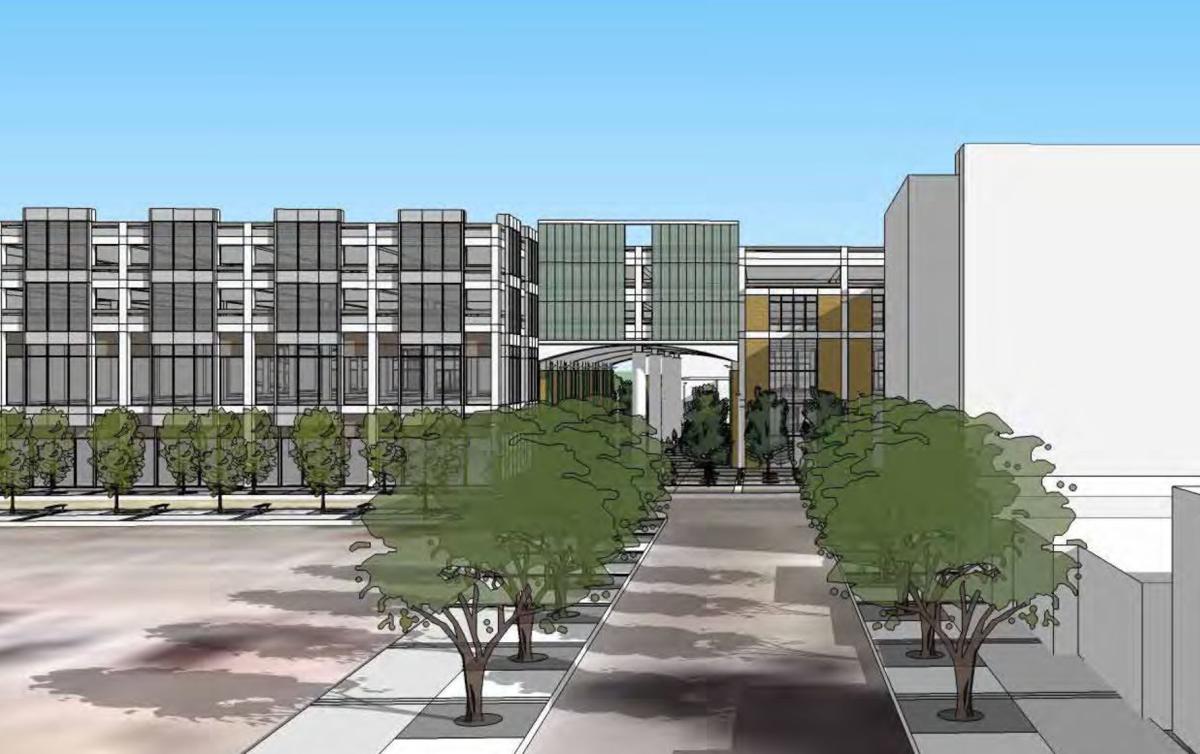

Wonder Falls, a proposed $150 million private development project once hailed as a potential “hub” of activity for downtown Niagara Falls, has been officially removed from consideration.
The project developer and officials from USA Niagara Development Corp., the state agency that oversees development in downtown Niagara Falls, confirmed Friday that the project, long envisioned to fill the vacant portion of the Rainbow Centre Mall building, will not proceed as originally planned.
As a result, the state will now “pivot” to a new state-financed and supported effort aimed at redesigning the structure to make it more attractive to pedestrian traffic and mixed-use development.
Uniland, the Amherst developer selected to oversee the original project by the state in 2014, initially announced plans for a large indoor water park and a 300-room hotel on the site.
In a statement issued by the company, Uniland Vice President Michael Montante said the project has since been deemed not economically feasible due to circumstances beyond the company’s control. He noted that the company spent “countless resources” performing due diligence, including site analysis, market studies, design schematics, meeting with potential operators and refining the resort’s scope.
“It’s project economics,” Montante said. “We pushed through many roadblocks over the years but, in the end, the project simply cannot be sustainable given the required costs.”
Uniland officials specifically cited a change in tax law last year that subjects state assistance to federal income tax, which they said significantly reduced the funds available to support the project. Montante indicated that both Uniland and ESD attempted to mitigate the significant negative effect to the project’s bottom line to no avail.
State officials also noted that much has changed in the landscape of downtown Niagara Falls since the project was originally pitched, including the opening of five new hotels representing an additional 610 rooms since 2014.
“The project team and I are disappointed that the years we spent developing and championing this project will not result in Wonder Falls coming to life,” said Montante. “We have consistently maintained that we are responsible stewards of public funds. In this case, the economics do not make sense and the prudent and proper decision was to end the process. As forces such as political policies and economic conditions shifted, so did the viability of the concept.”
The state has agreed to pay $129,000 to Uniland as reimbursement for producing various project-related reports. Those reports will be turned over to the state for use in supporting the ongoing effort to redesign and reconfigure the mall space for future development. State officials stressed that the state has not provided the developer with any additional funds to Uniland for Wonder Falls.
Borrowing a baseball analogy, Anthony Vilardo, the president of USA Niagara, predicted that, had it moved forward sooner, Wonder Falls would have been a “homerun.” He believes the state pursued the “right strategy” in supporting the concept, but that, ultimately, the “complicated” project was not able to overcome the various “realities” it faced.
Vilardo described the loss of the project as “bittersweet,” while indicating that’s he’s confident the state’s alternative plan will succeed and ultimately represent an improvement to the pedestrian and commercial appeal of a significant structure in downtown Niagara Falls.
“Now the thinking is, ‘What can we to do make an impactful statement on the downtown core?’ ” he said.
Vilardo said the state will not, as Uniland originally intended, attempt to add floors to the existing building to accommodate 600 hotel rooms.
The state remains interested, however, in pursuing another element of the original proposal – establishing a pedestrian “street” that passes through the lower two levels of the structure.
The “pass-through” remains an integral part of the larger vision for the site. State officials say it would reduce the big-box nature of the existing building and create a connection literally through the building between First Street and Rainbow Boulevard. In addition, they plan to line the connection with space for small businesses or shops, offering a potentially attractive retail component.
Other “civic improvements” eyed for the site include:
• Lessening the “monolithic” appearance of the connected parking ramp by incorporating new architectural features
• Undertaking additional concrete and elevator rehabilitation features and waterproofing measures
• Adding additional elevators to better facilitate the use of the parking ramp